Showing posts with label Amy. Show all posts

Saturday, June 8, 2013

A Letter to Future Students


I think we can all perceive the value in international travel, and travel in general.  Growing up, my family didn’t take a lot of very diverse vacations, and I always felt like I missing out on something really important.  This study abroad program was the first time I had the opportunity to leave the United States, as well as one of the very few times I’ve left the midwest.  Changing up the scenery, even for a few weeks can really break a monotonous cycle of “The Everyday”.  I chose this particular program because since childhood, I was fascinated by Europe, especially France.  I want to say it has something to do with my love of the children’s story Madeline.  In high school, I studied French for a year, and really enjoyed learning a new language for the first time, and being exposed to culture much different from mine.  

This trip came at very opportune time, as second semester Junior year, I was beginning to fall in to a rut, not really seeing any grand purpose in the things I was making, and lacking an ultimate goal that was reasonable and attainable.  I think I expected going to Paris to be some sort of inner-artistic renaissance.  Looking forward to the trip, I knew it would change me in a big way, but upon reflecting, I am surprised by what kind of changes took place.  They surely weren’t the ones I was expecting.  Being exposed to so many incredible museums, and such a density of crucial art works, the physical existence of work that I admire became very real to me.  Reading about a work online or in a text book can give a lot of information about how a work is read and what it means, but approaching a work in it’s physical environment, in an environment highly considered by more people than just the artist, has a great cognitive effect.  Realizing this was a really critical moment in my experience, and helped me better define my purpose in the scheme of the art work, and how my place as a viewer, and understanding of what “viewership” means, can inform my own work.  

These kinds of revelations are likely due the rapidity that I was experiencing the city of Paris, and all of the amazing things it had to offer.  When I wasn’t think about my exhaustion, or missing friends back home, or day dreaming, I was thinking about the movement of viewers, and the way art and ideas control our bodies and minds when experiencing them.  Sometimes I find myself writing the same few sentences down in my journal, over and over again, when I can‘t quite wrap my head around them, but in Paris I was filling page after page with content and ideas at a pace that surpassed my expected capability.  I have this new motivation to seek out art viewing experiences.  I always enjoyed going to art openings, and gallery shows, but now I value this interaction more.  

I think my trip to London after the Paris experience was really important as well.  Being in Europe is a great opportunity that many Americans don’t have very often, and I felt it was important to make the most of one trip.  I was only in London for two full days, and because of this, I really had to do some extensive research on how I wanted to spend such a short time.  I found lists of galleries I really wanted to see, and made sure a visit to Tate Modern was in the mix as well.  Because my visits to Paris and London were consecutive, I was able to compare their cultures, and pin point the aspects that I admired about each.  In this way, I was able to understand the values I look for in a place to live.  I came to Paris, expecting to never want to leave, but I left Paris knowing that it was not a permanent location for me.  The city is beautiful, and there are many places and social practices I admire about Paris, but I didn’t always feel like my lifestyle was congruent with the Parisians.  London was a little closer to a city I could picture myself living in.  I see more value in being critical of one’s place in a culture, than dreaming of full immersion, because that’s just not possible.  I want to continue to travel, both domestic and internationally, not only to learn more about the world, but to find places which really jive with me.  

In terms of preparing oneself for this experience, I would say, to expect to be tired, but really happy about it, and to try and sleep on the plane, even if you’re too nervous or too excited.  I would stress not being disappointed when you realize that you miss home, because you likely will at some point.  You’re definitely going to want some ear plugs, and most importantly, a bag with wheels is a lot easier to maneuver than a duffel bag so heavy that you have to hug it to take it anywhere (just a few logistical suggestions).  But one thing I cannot stress enough on this trip, is time to oneself.  It’s really easy to just follow a small group around on this trip, but remember, you’re sending three weeks with these people, with very few breaks, so it’s really important to take time to experience Paris on your own.  Even if it’s just a walk in the morning, or deciding to split off for even 15 minutes when the opportunity arises.  This experiences is for your own, individual benefit when it comes down to it, so take a little while (or a long while, if you can) and let Paris be your only influence.   

- Amy Trompeter

Tuesday, June 4, 2013

Movement and Space


In Paris I thought a lot about movement.  Looking at Calder’s kinetic sculptures outside of the pompidou, the stranger interaction between two different train cars, and the pace of running for a bus.  Noted in my journal is a quote by Eric from a group discussion which was, “If I don’t move, I have no proof that you aren’t flat.”  Movement defines our lives.  The thought of paralyzation, loss of mobility of any part of the body, or complete loss of limbs has always been a source of pity, rooted in a desire for movement, especially ease or enjoyment of mobility.  In Montmartre, I saw a man with no arms, not even stubs of arms, and I am still haunted by the concept of limited function, or limited ability to interact and move about the physical world; it is a basic, human need. 

From the moment I began this journey, movement was at the forefront of my mind.  The tiresome feat of international travel, days of walking across historic cities, up and down stairs, through amazing architectural feats, and life changing art exhibitions.  And in my final moments in Paris, a frantic run, with tears streaming down my face, desperately looking for a bus to take me to London.  Even the desire to simply inhabit other spaces on the planet, to feel the distance between our homes and our bodies, or to not feel it at all; space has a way of being beyond what is comprehendible.  

Being in Paris, and experiencing the most amazing museum and gallery exhibitions of my life has had a great effect on my educational trajectory.  I can feel a curator pushing my body through space, and understand how and why this is happening, and it is an amazing feeling.  The Ron Mueck exhibit was a defining moment of the trip, because it allowed me to really pick apart how spaces are manipulated and how viewers are orchestrated within that space, and how this creates meaning.  As a student of sculpture, I am often mesmerized by spacial relationships between physical objects, and for the first time in a very long time, I am able to better define potential career paths.  Not everyone is truly a studio artist, and while I love making and dream of having such a creative freedom, I realize that my skills and interests have many trajectories beyond studio art.  I find myself most excited when experiencing work by others, and I am starting to dig in to how the work has this effect on it’s viewers.  

My experience over the last few weeks has solidified the ground below my feet.  In a time when I was so unsure, and feeling uninspired, visiting Europe for the first time reminded me that there is so much more to see and know on the planet.  The only frustration I have is a desire to keep moving, to keep seeing new places, and to keep learning more about myself and the space around me, and defining the implications of that space.   

Friday, May 31, 2013

Dynamo : An Experiment in Duration, or Perversely Dense?


The exhibition at the Grand Palais, Dynamo covered an entire century worth of art dealing with Light and/or Movement.  The works presented ranged from overwhelming light installations, to op-art paintings.  As an enthusiastic, rather naive viewer, the exhibition itself proved to defeat me, mentally and physically.  The works were organized according to sixteens perceptual themes : openwork, permutation, concentric/eccentric, interference, immersion, distortion, tactile, grid, pulsing, abyss, force field, cloud, halo, maelstrom, uncertain space, and celestial.  That certainly seems like a whole lot for one person to think about in the course of a few hours.

Truth be told, I couldn’t wait to leave Dynamo.  I wanted to see everything, but after the first third of the exhibition, my head was throbbing, and my mind was exhausted.  I am enamored with simplicity, and Dynamo absolutely lacked this.  From one moment, I as bombarded by flashing bulbs, and almost immediately, another work was demanding my attention.  Contemplation was at a premium, and sensory experience demanded quite a lot from a viewer.  Dynamo took on a huge task conceptually.  If we consider light and movement as separate conceptual undertakings, there is surely enough quality content available to fill a space like the Grand Palais.  The institution was kind enough to provide sofas periodically for viewers to lounge between rooms, and take a short break, but I argue that the exhibition as a whole would have been stronger if these breaks were curated in to the space to create a more leisurely pace.  Just because movement is a focus in the exhibition, one cannot forget the many forms human movement takes, especially moments of stillness.  

Even as viewers moved in to spaces of darkness or slight blindness, the entry to these spaces was clumsy and anxious.  Entering James Turrell’s work “Cherry” I gripped the walls, stumbling in to other confused viewers and by the time I reached the space, my experience was disturbed.  I believe that the curators had good intentions by developing an anxious speed to move throughout the work, and by using moments of complete darkness to accentuate the presence of light, but these kinds of experiences are not welcome to groups of viewers.  When I attend an exhibition, I don’t go to be alone, I am aware that there will be many other people attempting to experience the work.  

Fairly soon after entering the space, I felt my eyes tiring, repulsed by op-art.  I imagine the rooms of paintings were designed to allow the viewer to rest for a moment and contemplate the work, but the images were visually harsh.  I appreciate ample space between objects, and felt the rooms of Dynamo were far too clustered.  It became easy to pass up whole walls of works because I was so


overwhelmed by the density of objects.  I wish that the curators at the Grand Palais had taken advantage of the abundant space by filling it sparsely, and really honing in on fewer works that better defined their goals rather than filling a space with vaguely connected works.  Sixteen topics of conversation is at least eleven too many topics for any exhibition.  While I appreciate taking on huge tasks, simplicity to me is poetry, and has a greater lasting effect.   


Ironic Tourist Activity and the iPhone Selfie as Self-Perservation


What started as a personal joke, quickly turned in to a trend amongst my fellow trip-goers, and even Chris started participating.  Observing the strange activities of tourism over the course of the first few days, I noted an activity I had never previously experienced in tourist culture: the selfie.  Arms extended out, iPhones or cameras in air, maneuvering the object to make sure a flattering angel is achieved.  I watched as groups of people thrusted their cameras in front of them, confronting a lens head on, placing themselves in the the same frame as a famous monument or work of art.  

It was hilarious.

And then I tried it.  My first selfie was at Notre Dame on the first official day of activities in Paris.  The irony was not lost on me.  I knew that I looked just as ridiculous as others taking part in the same activity, and several dozen selfies later, others picked up on the activity, and I wasn’t even laughing anymore.  I wanted align my image with these places.  I watched as others began to shamelessly take part in the same activity, and the absurdity developed.  It begs the question: is it more ridiculous to pose in front of an object or space that you wish to be depicted within, or to take matters in to your own hands?  At the Louvre, we collectively sighed at the sight of a tourist posing for a picture in front of images of death and violence, smiles stretched across their faces.  Their naivety only made me want to emulate such a ludicrous act, understanding all of the implications.  
In terms of contemporary culture, the selfie has made a lasting impact, so much so that the gesture has its own Wikipedia page (I do recommend viewing this.)  Digital photography has enabled the trial and error of this mode of self portraiture by allowing image makers to review their work and try again, and again.  

We all want to remember all of the wonderful places our bodies have inhabited.  Memory and legacy are topics of a majority of artworks (see: Portraiture, Representation), and function integrally as desires of humanity.  Images allow us to reflect on these important moments, and better yet, depictions of our own bodies in these spaces remind us of our temporary presences in that time or place. Growing up, both my father and mother were rarely photographed, living in rural 1960’s and 70’s culture.  I remember digging though drawers of my grandparents house, searching for shreds of their past, to inform my own disposition.  I always wonder if they feel as though they’ve lost some part of themselves, unable to reflect on their physical presence in the places and times which meant a lot to them.  Our culture is obsessed with images of self, because we’re trying to hard to hold on to the past, for benefit of the present.  

This is not simply vanity, the selfie gives us control of our own personal memories, and archives moments which were hardly possible to preserve even 10 years ago.  I am beginning to imagine my old children, digging deeply in to the internet, looking for a tiny bit of self in the images of my experiences.  While the selfies I am taking are still laughable at this moment, I truly think of them as valuable records of this incredible first experience outside of my American comfort zone.                  


I haven’t even taken a selfie at the Eiffel Tower yet. 


Thursday, May 30, 2013

Guyton/Walker takes on the Authentic

On my free day in Paris, I chose to return to the Pompidou Centre to spend more time with the contemporary wing.  I was previously unaware that New York contemporary artists Wade Guyton and Kelley Walker also functioned as a collaborative team.  This did not surprise me, as they live and work in the same city, and their individual bodies of work are compatible in terms of process and content.  The collaboration of well established artists is nothing new, Marina Abramovic and Uly, Björk and Matthew Barney, and aside from romantic collaborations, the Surrealists were notable for their collaborations.

An artistic partnership or collaboration inevitably calls in to questions ownership and authorship.  It is difficult to ignore the individual contributions of those involved in collaboration.  In the work present at the Pompidou Centre, Guyton/Walker takes on authorship head on.  The work questions how two notably different aesthetic values can come together to form a completely separate entity.  Guyton and Walker prefer to refer to their collaboration as third artistic identity, rather than a combination of artistic styles.  Their collaborative works are even represented by a entirely separate gallery. 

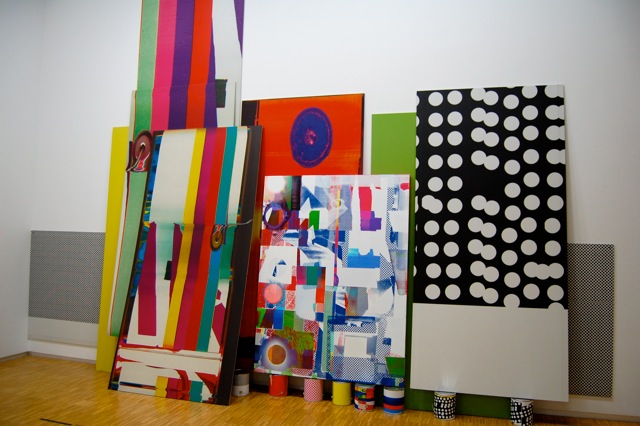
The work itself is several picture planes of black and white grids, distorted images of paint rollers, and strokes of color, leaning against the gallery wall, some balanced atop paint cans featuring similar imagery.  Using a variety of screen printing and laser printing techniques, reproduction and repetition is driver for the content of this work.      

I spent a little longer with this work than some of the other works in the area, attempting to understand the intentions of the artists and pay attention to their formal decisions more closely.  While analyzing their collaborative tactics, I was brought back to the essay written by Rosalind Krauss, The Originality of the Avant-Garde, which was assigned before coming to Paris.  The written work first addresses the role of authorship in terms of Rodin’s sculptural work, which continued production even after Rodin’s death.  The avant-garde perspective of originality and ownership is discussed in the section section of the essay.  Krauss discusses the avant-garde’s focus on the basis of originality, their relationship to repetition and reproduction, and obsession with the grid.  

The grid was described as the ultimate form, void of author or originator, and high susceptible to appropriation.  Guyton/Walker has appropriated this form in their work in the Pompidou on the panels to flanking both sides of the installation.  Guyton/Walker also approaches ideals of the avant-garde in their use of appropriated imagery, and the printing processes used to produce the images.  

Visual hierarchy is highly present in this work, as image planes fight for attention, jutting out from behind others, and struggling for height, standing on cans of paint.  Imagery of paint rollers, sculptural paint cans, and painterly shapes created through a printing process brings in to question the studio practice, and begins to form a hierarchy of studio technique.  This content present in a collaborative work complicates, as well as deepens, the self-reflexivity of a work challenging the notions of a studio practice.  The work seems to ask itself, “Who is my owner?  Where did I come from?” while visually drawing a viewer in through graphics and bright colors.  

I am still researching the individual studio practices of Wade Guyton and Kelley Walker to get a better understand of how their collaborative work exists independently, but also how this collaboration relates to their separate bodies of work as an artistic endeavor.                

Wednesday, May 29, 2013

Conceptual Levels : Ron Mueck


Ron Mueck’s work exhibited at Foundation Carier was far more than a spectacle.  While the precision of his craft has a “wow” factor, decision making in his representations spoke deeply of the human condition.  

The exhibition was divided between two floors, ground floor and a basement gallery.  The ground floor being made entirely of glass walls, offering challenging curatorial obstacles, as well as rare opportunities.  Between these floors, Mueck had freedom to make conceptual distinctions between the works present and compose a powerful viewing experience which forced a state if introspection equal to that of the figures present.  Mueck’s characters are cooperative, self-sacrificial, and self-aware; it seems we have walked in on private moments of connection (or maybe more appropriately, disconnect) when approaching a sculpture, imposing the role of voyeur on the  audience.  This intrusion is not purely sexual, but still has the ability to make a viewer uncomfortably engrossed in a moment.

What is a more appropriate material to suggest voyeurism than glass?  The sensitive use of glass walls and natural light on the ground floor frames the works as well as a contextual space for the figures to reside.  When one first enters the building, the striking image of a larger than life elderly couple sharing a beach umbrella invades the space of the main gallery on the left.  This sculpture is visible from outside the building, from nearly every angle, including the street.  At a distance, one feels as though they have stumbled upon an uncovered window, and up close, the viewer looks up, in to the sweet moment of a man resting his head on the leg of his wife.  The woman looks down at her counterpart, as he looks off in to space.  The room is empty, apart from a couple of benches, and the space around the objects extend past the glass walls of the building and continues in to the surrounding garden.  The feeling of a beach is represented in more than just a colorful leaning umbrella.   

Three objects inhabit the second room on the ground level.  Upon entering the space, viewers are startled by an enormous dead chicken, plucked of its feathers, hanging from a hook by the ankles.  Upon moving around the object, a large gash along the neck of the chicken is revealed; its closed eyes are damp from a final cry.  Across the room are two female figures, one of a nude woman, bent over backwards, carrying an ample bundle of sticks, which greatly surpass the mass of the figure, and another woman with a newborn bundled close to her breast, and hands full of bags of groceries, staring blankly in to the distance.  

The figures on the ground floor, while demonstrating a sense of balance and weight, all demonstrate the sacrificial nature of living life for another, from a simple gesture like sharing an umbrella, providing for another’s lean, nearly breaking one’s back to transport bounty, and even sacrificing life itself.

Upon descending the stairs, the viewer enters a space impacted with even more surprises.  An enormous, sleeping face greets us.  Approaching this object, it is revealed that there is nothing behind it, only empty space, only a mask of what could very well be a self portrait of the artist.  In the basement gallery, the viewer is confronted with moments of realization of the body or self, whether it be a bodily wound , or deciphering disconnection with a significant other.  Throughout the viewing experience in the lower level, the potential gaze of man, arms spread like Christ, looms.  A man in sunglasses, lying on a raft floats across a deep blue far wall.  Framed and spatially separated by gallery walls, the man’s gaze is indefinite, unlike the distant gaze’s of Mueck’s other figures.  This gaze is present, but concealed.  Does this figure take the place as voyeur in the basement level?  

It seems that Mueck used the two vastly different levels of Foundation Cartier to present an ever-present human dilemma of sacrifice on the ground floor, and to sink in to introspection and awareness of the body and mind in the lower level.  In this way, Mueck presents literal layers of concept, and uses a (highly orchestrated) time-based experience to thrust the same questions upon the viewer. 


Tuesday, May 28, 2013

Centre Pompidou : Why it's okay to cry at a museum, and why you should try it.


Allow me to explain.  I have thoroughly enjoyed all of the places we spent time in over the past week, some more than others, but overall, I took a lot away from them.  With that being said, I have been itching for something more contemporary.  Looking back hundreds of years has been valuable, and has enriched my sense of art history through first hand experience with the works only known in textbooks.  

However :

I haven’t been able to form an appropriate combination of words to objectively explain the mental and physical reaction to stumbling upon Plight by Joseph Bueys.  One can read as many wikipedia pages as they please, and page through art book after art book, but print media cannot translate the smell of several hundred dense rolls of grey felts, or the temporary deafness experienced by the lone viewer.  Images, though unmoving, cannot do justice to the stillness of an silent grand piano.  It is truly suffocating. 

First hand experience has been the most crucial aspect of my time in Paris.  Being among great works of art, I can understand their scale and context appropriately which paves the way for a critical response to the work.  Growing up in a college town, and living in a smaller city like Milwaukee, these amazing works of art rarely feel within reach, but my time in Paris has forced me to realize that my favorite works are real, physical things beyond an image or descriptive paragraph.  I better understand how attainable these first-hand experiences are. 


Friday, May 24, 2013

Musée Rodin and Musée d’Orsay

As a student of sculpture, Musée Rodin was an excellent experience.  I am not interested in figural sculpture in my own work, but there were many elements of Rodin’s pieces which made me consider essential goals of sculpture.  Before this trip, I had never spent much time thinking about the qualities of marble, and experience Rodin first hand has established a great appreciation for the material.  The first work which really peaked my interest was in the special exhibit, “The Convalescent.”  The work was carved of marble, and upon approach, seemed to simply be boulder, but upon closer inspection, a head and folded hands become visible.  The figure seems to be growing from the stone, but is still very much trapped within.

As I previously stated, I have never been very familiar with the material of marble, but I always assumed it to have a clean, milky appearance similar to plaster.  But marble has a luminance that could never exist with an opaque material like plaster.  “The Convalescent” was a wonderful example of the versatility of marble.  According to my memory, traditionally, a marble sculpture, especially a figure, has a highly polished surface with some texture to differentiate between fabric, hair, etc.  Rodin’s work, on the other hand, taught me that marble can be ugly, too.  “The Convalescent” was not his only marble boulder with figures “growing” from them, there were a few others in the room.  In fact, may of the full figures had some sort of “raw” marble present.  I really appreciated this material use.  “The Convalescent” also seemed to float on the pedestal, due to the presence of a heavy shadow jutting from under.  This sense of floating did not make the work appear lighter, however.  The work still had a great sense of weight and density.  

Something which really struck me in the marble works was the contours and faces created by removal of material.  I wish I had been able to take pictures in the space, because some were very complex, and I don’t think my drawings quite did them justice.  This removal of material was important to note in may works, as well as the contours of bodies.  Rodin really works with weight and movement of bodies, and often defies what we believe to be possible.  

In my journal I listed a few things the work seemed to “tell” me :
  • “Marble can be ugly, or very rough, too” or
  • “Marble can be beautiful even without a perfect surface” 
  • “Marble can be the subject of a sculpture”
  • “Marble can be the subject of a portrait”
  • “Gravity can be the subject of a portrait, even when gravity is always a subject in sculpture.” 

However, the work I chose to spend a little more time with was in fact two works : a model vs. the final marble. 

The work was located in a room in the upstairs of Rodin’s home.  I was looking at a few Van Gogh paintings and turned around only to see a startling amalgamation of materials directly across the room. 


This work was a model made of terra cotta, plaster, ceramic, and paper-maché.  The sculpture was of a “sleeping” woman, but when created through this variety of materials, the sleep seemed more like finite one.  The pallor of facial flesh was so opaque, it seemed stiff and dry like an egyptian mummy.  It was almost disturbing to look at, the way the materials were pressed together an crudely depicting a figure.  It took me several moments to realize the final marble version of this model was located directly next to it.  I couldn’t believe the two objects were describing the same figure.  The marble object was luminous and angelic, a drastic contrast to the crude model. Both have a sense of mortality, but in completely different ways.  The model, a post-mortal figure, and the marble, a heavenly depiction of the figure.  


Process is drastically different between the two works.  The model was created through a very hands-on process of pressing material together, while the marble was carved and polished using tools.  The model suggests aspects of transience, while the marble feels very finite, which is appropriate considering their purposes.  As well as the weight suggested by both objects.  The massive bottom portion makes the marble work’s placement definite, and does not in anyway suggest movement, but the model appears much lighter, as layers of paper are visible beneath, suggesting a hollow form.  The objects are roughly life sized, and are about as tall as the lengthen between the tips of my fingers and my elbows. 

The placement of the works, and the objects they sat on were different, which was interesting to me.  The model was on a traditional white pedestal, and enclosed in a vitrine.  I imagine this is due to the materials used and their temporary quality.  The marble, on the other had sat on a wooden stool used for a few other marble works in the room.     

The treatment of the surface was integral to the work, as in the model, a great variety of surface textures are created by the different materials and gestural application process, while the marble used more linear mark-making to designate a variety of textures.         


 While sitting and reflecting on the work, I noticed the paths created by foot traffic in the texture of the floor.  My path through the room moved in a circle, clockwise through the room to finally land at the model.  My specific movement through the space can be see in the images in my journal.  

There is a path heavily tread between the works by Van Gogh and the model.  When I realized this, I felt like this placement was a very intentional decision by the curators.  The model looked like nothing else in the museum, and was a huge surprise to stumble upon especially after viewing a few Van Gogh paintings.  I have a feeling the curator would expect viewers to be attracted to the Van Gogh paintings, and upon turning around, there the model would be. 

The pedestal felt intentional in this way to grab the attention of viewers in the room, as if to say "This is interesting! Come see this!" 

Comparing these works gave me quite a lot of insight in to Rodin's process, and was extremely surprising to see such gestural marks in terra cotta inform a material like marble. 


Journal Pages :


- Amy Trompeter


Tuesday, May 21, 2013

Days 1-3


I imagine this observation is fairly universal among the folks on this trip, but the most prevalent theme I have picked up on since the beginning of the Paris study abroad experience has been the antics of tourists.  With that being said, I cannot ignore my actions of the past four days.  Yes, I have chosen to take pictures in spaces densely populated with others foreign to Paris, France, and Europe, and I have done this shamelessly many times (See : ironic “selfies”).  However, looking back to the few times in my life when I have taken vacations to or visited places which were new to me, I was definitely guilty of taking pictures of every possible thing instead of a first hand experience.  I think this instance (one of many) where higher education has forced me to reconsider my initial inclination.  I understand the importance of really looking at the space around me, instead of immediately forcing a camera in front of my face.  Humans are driven by desire and memory, although at times those two contradict each other.  We want to hold on to the moments which excite us, and the easiest way to do that is to take a picture.  Upon reviewing these images (if you ever actually do), the better parts of  the moment are lost.  Of course, photographers have a greater ability to make images of these special moments and create a lasting impression.  As a student of sculpture, I think about space constantly, and how my body and other bodies maneuver the objects or lack of objects in a space.  It is difficult for me to conjure these memories in my chosen medium (maybe this is an appropriate challenge?)  

I cannot deny it.  The tourist culture in Paris is beyond anything I have ever seen.  I have been to music festivals, concerts, spaces of high traffic, but there is absolutely nothing as claustrophobic and utterly disappointing as the palace at Versailles on a Sunday/national holiday.  I’ve read about Versailles in many textbooks, and seen images in numerous slide presentations, and nothing really compares to being in the real, physical space.  But on the other hand, nothing compares to physical interaction I had with the space on Sunday.  Smashing in to bodies of all sizes, worried about pick-pocketers (See : crippling fear of crime and theft), and wanting to enjoy the luxury of such an estate, all at once.  In retrospect, it is unfair to call the experience disappointing.  If anything, this reaction is completely appropriate for such a spectacle.  One thing I have become highly aware of in the past four days is the collision of spectacle and human reaction.  

It is easy to compare the way people react to the spaces at Notre Dame, Versailles, and the Louvre.  I attended the mass at Notre Dame in the time we were allotted, and I considered it an extremely rewarding experience as an individual who spent an hour each week in Catholic mass, and numerous other hours learning about the Bible among other aspects of Catholicism.  I haven’t been to a mass in quite awhile (honestly, not complaining) so it was interesting to follow the mass in French, and observe as many differences and similarities that I could, and interact with others who were a part of the mass.  At times, I felt that I was acting inappropriately, but in reality, I cannot ignore the intended use of a space, one for worship (and one for impressing all of the Catholics in the area, so they come to your church, but that’s beside the point).  I didn’t want to follow the paths allotted for tourists, they felt very stale and in-genuine.  I remember after the mass, when I decided to walk around the church in the path that all of the other visitors had, I saw a few individuals who seemed to be taking in the experience and really deep within it, likely due to their devout faith.  I hope that those people took a while to attend the mass and really experience their faith in a more genuine way.  Yes, seeing the spaces specified for prayer and worship were powerful, but I hope that those truly affected by their time in Notre Dame defied the boundaries to be a part of the space in way which could strengthen their faith even further.  I remember being so enamored with the way they interacted with the space, and how I could read even just a small fraction of their experience in their facial expressions.  I am often searching for a heightened sense of purpose, and am envious of individuals who have found their fit.     

Taking communion that day, I waited in the line, nervous.  I was trying to remember the appropriate way to accept communion, and I felt so self conscious.  Maybe this feeling was due to a severely sacrilegious desire to simply experience culture, completely devoid of a current belief in God; I was riding on memories of a greater part of my life, and the things I learned in those times.  This experience was absolutely valuable to me in a way I have felt continuously during this trip; I am such a small person.  

Being in this city, outside of the United States for the first time, I have realized how tiny my one person is, and how many people are running around looking for the exact same (or wholly opposite) experiences and feelings that I am.  Less than four days in to this trip, I am feeling an emotional and bodily experience that I knew would occur, but did not expect the full impact of.  It’s amazing that attending a mass at Notre Dame would have a huge impact on me, possibly for all of the wrong reasons (in terms of faith).  I remember registering for this course and trying to decide whether or not to assign myself to the Art History or Humanities credit.  I had intended to focus on Art History, but my friend Zach convinced me otherwise (due to the likely potential for more stimulating Art History courses available that I would be interested in taking).  But being here, I feel I am in search for the “humanities” experience, and will always be.  I love unique experiences, I love telling and hearing stories, and while this may seem like a historian at heart, I thrive on human experience.

In terms of my time at Versailles and the Louvre, I could measure the perceived “value” of space.  At Notre Dame, the visitors treated the space with incredible respect, taking pictures and moving through the building as silently as possible, concentrating on the power of religious experience and the relics of this human undertaking.  There was a perceivable hummmm that moved throughout the space.  This sound was notable, one of thousands of people quietly moving thorough a space; there are truly few places where one can experience this.  Tourists treated this place with respect.  

This was absolutely not the case in Versailles.  Versailles is a symbol of wealth and extravagance, and as one attempts to seem as much as possible of Versailles, envy is inevitable.  On the grounds of the garden, there were many moments of silence and contemplation, but upon moving in to the major palace, these moments of contemplation were shattered with the first shove.  I wanted so badly to see the main palace and appreciate it’s architecture, but with such an overwhelming crowd, my experience was one of stress and anger towards absolutely everyone inhabiting Versailles.  I was but one person in a non-stop, aggressive stream of people.

I think “time” was the theme of wealth that I could perceived the strongest.  The time it took for one to see the entirety of the grounds, the skewed time-space relationship when viewing the garden from the palace, and undeniably the leisure time associated with living at Versailles (as a King!).  I could not stop thinking about the time spent building such an environment.  Every moment of the park was so considered and intricate.  Time is money, as they say.    
  
The Louvre was an interesting middle ground.  While there were the same (seriously, absolutely the same) people at the Louvre, there was a respect for others that was not present in Versailles.  This was likely due to the available space, but I felt that in the space of art, people tend to act respectfully, similar to the way tourists moved through Notre Dame.  It must be universally culturally accepted to respect religion and the arts, and resist monarchy and incredible wealth (gee, I wonder why).  

Tourism is absolutely strange.  Today, a woman used my head as a pedestal with which to take a picture of Titian painting.  Desires are so strong (and for what reason, might I ask?) in spaces heavily populated with tourists.  I feel apart for this, ignorantly.  I am part of the spectacle, but I am disgusted by it, and I react in a satirical way, but my money went to the same place that the rampant tourist’s money did.  I realize that these first few days of the trip cover these tourist-y spots to set a ground work, and the entirety of the trip will not have such highly concentrated frustration, but I think this is a great place to start.  This understanding will set a groundwork for the rest of the trip that begs for reflection and consideration.  

Jeez, I said experience so many times.  


The works I chose to spend extra time with in the Louvre were “Pygmalion et Galatée” by Anne-Louis Girodet de Roussy-Trioson, located in the hall of French painters, and a sculpture by Proxitéle titled “Aphrodite du type de la Venus d’Arles dite Venus Cesi.”  The works deal with the tradition of the female nude in marble.  The Pygmalion painting is a depiction of a sculptor who falls in love with his sculpture and the goddess Venus brings the sculpture to life and Pygmalion marries her.  Proxitéle’s female nude is a depiction of Venus, and is one of the first female nudes in sculpture. 


Scale wise, Pygmalion's scale is comparable to the human, but Proxitele's sculpture is slightly larger than life.  In both the image and the sculpture, the female figure is placed on a pedestal, accentuating the figures relation to the viewer.  In the case of Proxitele's figure, the woman seems to tower over.  She becomes the dominant figure. 


The approach to Proxitéle’s marble is framed by hoards of museum go-ers grouped around the Venus de Milo, pushing closer, taking pictures.  Surprisingly, very few people seemed to be interested in Proxitéle’s Venus, even though it’s significance is nearly equivalent.  At this point I became very aware of the ways that museums control the works that garner a lot of attention.  The Venus de Milo was featured in the museum map, influencing visitors to see the work.  Proxitéle’s Venus was given it’s own room with her back turned to the Venus de Milo.  The curious viewer would naturally pass the busy room of Venus de Milo and find Proxitéle’s Venus, alone.  

The Pygmalion painting was plagued in a similar fashion, in proximity to the Mona Lisa, located in the french painting hallway.  The time spent in front of the painting was spent waiting for tour groups to move out of the way of my viewing area.  The painting itself is one of the more noticeable paintings on that particular wall due to the brightness of the colors used in contrast to the Pompeii red of the walls and dark colors present surrounding works.  

Studying the gaze was extremely important when comparing these two works.  In the painting, the male figure looks up to the female figure in admiration, as she stands on a traditional sculpture pedestal.  In the sculpture, the viewer is put in the place of the male, and looks up at the monumental figure.  The female figures, on the other hand, are looking down and to the left, but not to any specific person or point.  


The hands in the Pygmalion painting are accentuated by light, but none are ever touching each other, implying a separation between figures.  In the case of the sculpture, the viewer is not allowed to touch the marble sculpture, for obvious reasons, however if a line was drawn between the hands, a compositional fifth line is created.                 


Journal Pages :


I was struggling with drawing diagrams because I  write in a journal regularly and never draw, so it was difficult to get the hang of drawing what I was seeing and still being able to process my thoughts in a fluid manner.  But I think I'm finally getting the hang of it!


- Amy Trompeter