Showing posts with label Natalie. Show all posts

Saturday, June 1, 2013

Natalie_The Star & The Arab Institute


The Star & The Arab Institute


I have decided to focus on the eight sided star in my research paper which will carry into my studio practice for the end of our trip. I discussed with Chris and Eric how the star popped up in many unexpected places throughout our trip here in Paris. Variations on the star,  like the five sided version, came up in churches/chapels and even at the opera. 


Here the star makes an appearance in the smallest parts of the "aperature" style windows at the Arab Institute.

Its difficult to see with the quality of this photograph but even the bolts in the water grates of the sidewalk had a star shape to them.  


Here the star shape is carried out throughout the courtyard tile


Today I was also able to visit Mussee du Nassim Camando which is pictured above. Named after a son of the wealthy banker who owned and built the property, the Masion houses an amazing art collection from a prestigious family of the 20th and 21st centuries. I gathered that eventually the family did not make it past WW2 era, however when the father and owner of the property grew old he willed the estate to France in the 1920's.


Natalie_Mussee d'Orsay


Mussee d'Orsay 

The Mussee d'Orsay was one of my favorite museums on the trip. It was built as a railway station, the main one in and out of the city. Since then it has been converted into a museum, however the station itself still makes itself present in the current architecture and the metal work. The way the light is able to enter the numerous glass skylights and flood the main entry way with natural light allows the sculptures housed there to be shown to their best ability. 

One of the rounded skylights that are present at the Orsay 


The large train station clock which has elaborate gilded leaves on the side. 


The d'Orsay had a beautiful Art Nouveau permanent exhibit. Photographs were not allowed but I snuck this one in of an Art Nouveau Jewelry piece. The exhibit housed furniture, rooms with the recreation of wall panels, and the detail work on furniture sets. Until viewing this exhibit I had aways been intrigued by Art Nouveau but wasn't quite sure if I was crazy about the end aesthetic. However, this walkthrough completely changed my mind and cemented Art Nouveau as something I would have loved to have been a part of. The way the environment created a "trickling" and organic feel immediately. 

Natalie_Ron Mueck

Ron Mueck


Progression 

The exhibit by Ron Mueck was amazing to say the least. In a nutshell I feel like it pulled the aspects of curating we have been discussing since the beginning of the trip. The intention behind the layout of the pieces was so thoroughly well imbedded in the content of each individual piece that the progression through the exhibit was one of the best and well laid out I have yet to experience. It is as if you are progressing through a personal change as you make it through the exhibit. 


The Building

Jean Nouvel was the architect for the building which housed Ron Mueck's exhibit. The building had moving glass walls and a design that allowed his sculpture pieces to interact with the natural environment of the garden/courtyard in the back of the building. 


Friday, May 31, 2013

Natalie_Hair Exhibit


Hair and Pride


While visiting the Quai Branley museum we not only were able to see primitive pieces from the Philippines, we were also able to see those pieces juxtaposed against a special exhibit about hair and how it has kept its significance for a number of tribal rituals over the years. 

I had made it halfway through the exhibit when i came upon a video piece that was showing woman during the 30's era who were suspected of sleeping with the enemy getting their hair shaved. The photographs, but especially the video were so haunting to me. I know much about the history of World War 2 and the surrounding years, however, I wasn't aware that the shaving of heads extended to friends of the enemy in this way during these years. 


From my Notes: 
in the museum there is
marching
i hear it in the back, behind the walls
its the shuffle shuffle I imagine she made
as they poked her back
back in line
and I didn't think they were the enemy
I dont even know her
or them
or if they were nice people
but I do feel 
that they 
dont deserve to 
be cut

And these were some more photographs from the rest of the exhibit. 


Thursday, May 30, 2013

Natalie_Picasso Reflection

Comparison at the Pompidou


While at the Pompidou I did a comparison on Pablo Picasso's pieces Fillet au Cerceau (1919) & La Liseuse (1920). Using the six scales I deduced that an underlying explanation for the pieces and the way they are composed is a reaction to the war and the end of World War 1. Pablo Picasso, among others began to revert back to a idealistic way of painting in reaction to the soldiers returning home scarred, battered, and often time missing limbs. I suspected that it could have been a sensitivity to the way his prior painting could have been conceived as too similar to depicting he reality of the time.


Natalie_Pompidou

Pompidou

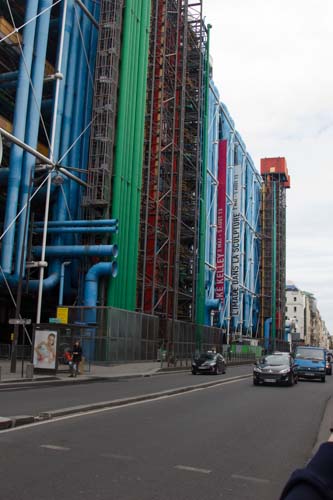
The guts are on the outside. That is one of the more candid ways Eric described the Pompidou. Initially, when I saw the building from afar during our first week I was very skeptical about whether it would impress me or not. I thought I knew the reasons it was impressive to others. It seemed obvious that the curving tunnels on the exterior where some sort of nod toward the feats of modern architecture and that would likely attract less traditional minded people. However, I was pleasantly surprised about 5 seconds after walking into the amazing shadow of the building. 

The Pompidou is more than just guts on the outside. It is a way of building so the people that utilize the area feel included in the function of the facade. The architecture found a way to bring the outside to the people as a way to welcome them into the function, process, and utilization of the place as a whole. 

We saw the control a building has over its neighborhood here more than any other place we have been so far. In this area we saw the Pompidou centralize a neighborhood  by cementing its industrialized architecture next to a park and local restaurants. Together these things create a grid, a giant “square” where people are circulated from one thing to the other and can find a way to “exist” in a variety of interactive and healthy ways. Here we see it happening in modern architecture, a park with a pond, and a chapel that exists within the contemporary space. 


The "Squirrel" Cage as I would like to call it but technically the escalator housing which is exposed in clear glass outside of the building. AWESOME VIEW OF THE CITY! (see below)

Example of how the park with the old steeple interact with the landscape.  Here the Pompidou is behind me. 


Natalie_La Corbusier Home

Natalie Eichers
Looking at Photography in a Painterly Way

The La Corbusier Home was located in a small residential neighborhood. It began our walkthrough of modern architecture, beginning with Art Nouveau and moving toward contemporary structures. 

Our assignment prompt was to look at Corbusier's painting which was hanging within the house. Initially I looked at the assignment in the wrong way. The prompt was to photograph in a way that reference the painting as a whole, however I photographed in a way that referenced PARTS of Corbusier's painting. Even though the prompt wasn't followed the correct way I do feel like the photographs that came out of the assignment are valid representations of the way the architecture of the home allowed light to interact so successfully with its furnishings and interior space. It still also allows many similarities to be revealed between Corbusier as the architect and Corbusier as the painter. 


The following photographs are sometimes simplistic but are relevant to the aforementioned painting by the colors they include, the shapes they draw attention to and the intersection of line and shape. 


Monday, May 27, 2013

Natalie_Rodin


Blog #3

Rodin 

Regarding Marble: “Carried the mark of the master, even if several hands had collaborated on a piece”

On Day 6 we ventured to Rodin's home which houses his sculptures. Rodin left all of his molds and his existing work to the french state when he died. In exchange he was taken care of later in life and lived in a very beautiful estate with a wonderful garden to work in his later years completely free.


The building is split into two parts, one made up from his original home and a special exhibit building that showcases his work in a more gallery like space. See the sketches below for the layout of the first space.


First Space, Gallery Space which had his sculptures on wood pedestals and had gray walls. The white of the marble looked perfect against the atmosphere created. 

Notes on what struck me first

Layout of the room 
Once I was done inside the gallery I moved out to the gardens and then into the house of Rodin. The Sculpture I choose to study was titled "I am Beautiful" and it is a sculpture made from plastic and it depicts a "unreal" looking account of a man lifting a woman up and towards his body. The inaccurate bending of their bodies is really what makes it so amazing and interesting, along with the thought provoked from it...is the man really there? Does the woman know she is being lifted?
Once Inside, the layout of the room of the I AM BEAUTIFUL sculpture. 

Notes regarding the sculpture


quick drawing


And now for some photos...